
Last August 2025, our colleague Marta published a fascinating post on this blog sharing her thoughts on the book we're reading this month. If you'd like to delve into all the nuances of this story, click here to read the Marta's contribution post about "Trust" - My Own View .
Sections of this post (click to go)
- The Author
- The Book
- Videos
- Discussion Questions
- Financial Vocabulary
- Mini Financial Timeline: 1929
- List of Characters - Who's Who in "Trust"

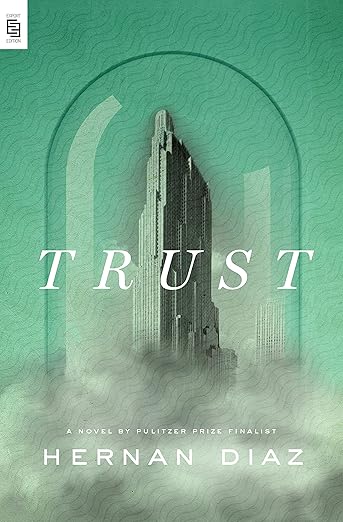
His debut novel, In the Distance (2017), was a finalist for the Pulitzer Prize and established him as a bold and innovative literary voice. However, his second novel, Trust, marked a turning point in his career. Published in 2022, the book received widespread critical acclaim and won the 2023 Pulitzer Prize for Fiction.
Trust significantly elevated Díaz’s international reputation. The novel’s ambitious structure and its exploration of capitalism, financial power, and authorship positioned him as one of the most intellectually daring contemporary writers. The success of Trust confirmed his status as a major figure in 21st-century literary fiction.
 |
| Source: Amazon |
How would you compare Ida Partenza and Mildred Bevel? What do they have incommon, and what makes their lives and ambitions very different?
In Part III, Ida learns more about the Bevels and becomes involved in Andrew’sproject. In Part IV, we finally hear Mildred’s own voice.How does each part change your understanding of what really happened?
Andrew has enormous financial and social power, while Ida has very little at thebeginning of Part III. Mildred is also in a complicated relationship with Andrew.Who has power over whom in these relationships? Does this power changeduring the novel?
Compare the Mildred we see in “Bonds,” “My Life,” and “Futures.”Which portrait seems closest to the woman you imagine as the “real” Mildred?What makes you think so?
Andrew wants to control the story of his life, Ida helps him write it, and Mildred alsouses writing to express her own ideas.How is writing connected to power and control in these two parts? Who istrying to control the story, and why?
Why do you think Díaz calls Mildred’s section “Futures”? What different meaningscould the word futures have in relation to Mildred’s life, her relationship with Andrew,and the financial world of the novel?
In Part I (“Bonds”), we read a story about Benjamin and Helen Rask.In Part II (“My Life”), Andrew Bevel tells his own story.○ Which version feels more believable to you?○ Why?
○ What are the biggest differences between Benjamin Rask and Andrew Bevel?○ How are their wives (Helen and Mildred) different in the two texts?○ Why do you think these differences are important?
○ How does each part describe rich people and the world of finance?○ Does Part I criticize rich people more?○ Does Part II try to defend them?
Compare Helen and Mildred.○ How intelligent and independent are they in each story?○ Do they seem strong, controlled, misunderstood, or something else?
○ How is the crash described in both parts?○ Is Bevel/Rask responsible in any way?○ Does each story judge him differently?
Part I reads like a traditional novel.Part II feels like a personal explanation or defense.○ How does the style change your opinion of the characters?○ Which style did you prefer?
○ Why do you think Andrew Bevel wants to tell his own version of the story?○ What does this say about power and reputation?
Both men seem distant and emotionally cold.○ Why are they like this?○ Is their personality connected to money and success?
○ After reading both parts, do you think we can know the “real” truth?○ Or does the novel suggest that truth depends on who tells the story?
○ After reading both sections, whose story affected you more?○ Did your opinion change between Part I and Part II? Why?
After reading the timeline, reflect on the following questions:● How does knowing this timeline change your view of Bevel/Rask?● Is he a genius investor — or someone who benefits from crisis?● Does the crash seem like an accident, or something predictable?
● Buying shares or assets expecting prices to rise quickly.● In the novel: Investors in the 1920s (including Rask/Bevel) often take big risks to make fast profits.
● The buying and selling of company shares.● In the novel: The rise and fall of shares drives the characters’ wealth and anxiety.
● A sudden, steep fall in stock prices.● In the novel: The 1929 crash affects everyone’s fortunes and shows the fragility of wealth.
● The accumulation of extreme wealth in the hands of very few people.● In the novel: Bevel’s rise illustrates how few can dominate finance and public perception.
● The idea that trust and fame are as valuable as money in maintaining wealth.● In the novel: Bevel carefully shapes how people see him, almost like managing a financial asset.
● The possibility of losing money due to investment decisions.● In the novel: Risk-taking drives both the success and the near collapse of fortunes.
● Giving money to cultural or educational institutions to secure social influence.● In the novel: Bevel uses charitable acts to cement his reputation and legitimacy.
● A period when the economy slows, businesses fail, and unemployment rises.● In the novel: The aftermath of the 1929 crash creates wider social and economic consequences.
● Knowing something about markets or investments that most people do not.● In the novel: Wealthy investors like Bevel benefit from information and influence that ordinary people don’t have.
● A false sense that wealth, markets, or power are secure and predictable.● In the novel: Both narratives show that fortunes can vanish overnight, despite appearances.
● The U.S. economy is growing quickly.● Many people invest in the stock market.● Stock prices rise very fast.● Some people buy shares with borrowed money (this increases risk).● There is a lot of optimism and speculation.👉 Connection to the novel: This is the world in which Rask/Bevel becomes extremely wealthy.
● Experts begin to worry that stock prices are too high.● Some investors quietly start selling their shares.● The market becomes unstable.👉 Discussion link: Who understands the danger? Who profits from it?
● Many investors panic and try to sell their shares● Stock prices fall quickly.● Banks and large investors try to calm the market by buying shares.
● Panic continues.● Millions of shares are sold.● Prices collapse.● Many investors lose everything.👉 This is the moment usually called the Stock Market Crash of 1929.
● Thousands of banks fail.● Businesses close.● Millions of people lose their jobs.● This period becomes known as the Great Depression.

|
In Bonds
(fictional novel) |
In the other
parts |
Role in the story |
|
Benjamin Rask |
Andrew Bevel |
New York financial magnate whose fortune and reputation
are at the center of the story. |
|
Helen Rask |
Mildred Bevel |
An extremely intelligent and cultured wife; her true role
in the fortune is one of the mysteries of the novel. |
|
Leopold |
Helen's Father | |
|
| ||
|
Doctor treating Helen |
Mildred's Doctors |
They intervene during the wife's illness. |
This shows how the first part rewrites real history, changing names and emphasizing certain features.
2. Main Characters for Each Narrator
Bonds - Fictional story inspired by the Bevels.
• Benjamin Rask – mysterious and extremely wealthy financier.
• Helen Rask – brilliant wife whose illness dominates the plot.
________________________________________
My Life (Andrew's autobiography)
• Andrew Bevel – attempts to rebuild his public reputation.
• Mildred Bevel – presented as a refined wife and music lover.
• William Bevel – Andrew's father, a key figure in the creation of his wealth.
• Adelaide Bevel – Andrew's mother, associated with high society.
No comments:
Post a Comment
Thank you very much for your comment.
We are waiting for you soon!