"The Truth of Fact, the Truth of Feeling" is a science fiction story by American writer Ted Chiang. It was first published in 2013 in Subterranean Press and later included in Exhalation, a collection of short stories published in 2019.
The story is written as an article by an unnamed journalist in the near future, who tells his experience with a device that endows its users with photographic memory, interspersed with a fictionalized account of an incident in which writing was introduced to an African tribe. The story serves as a reflection of how improving human memory affects people's personal lives.
Ted Chiang is an acclaimed American science fiction writer celebrated for his short stories. Both of his parents were Chinese and fled the communist revolution in 1949. Over the course of thirty-five years, Chiang has written two short story collections (Stories of Your Life and Others and Exhalation), along with countless other short stories and op-eds for publications such as The New York Times and The New Yorker.
His stories often blend science fiction with thought-provoking themes. Examples include "Tower of Babylon," a retelling of the Tower of Babel story, and "Story of Your Life," which explores time perception through a linguist deciphering an alien language. This latter was made into a film, Arrival (2016).
Sources: Wikipedia, Britannica, Penguin website.
QUESTIONS TO REFLECT
We are going to use the following questions to spark our conversation during our next meeting. Think how you would answer them.
1. Is remembering something accurately always better than remembering it imperfectly?
The story contrasts factual accuracy with the way our memories and feelings shape our understanding of the past. Can an inaccurate memory sometimes be more valuable—or even kinder—than a perfectly accurate one?
2. Would you want a device that could record everything you experience and allow you to replay it exactly as it happened? Why or why not?
Think about both the advantages and the possible consequences for relationships, personal identity and privacy.
3. The story suggests that there can be a difference between “the truth of fact” and “the truth of feeling”. Can both be true at the same time?
Can you think of situations in real life where the objective facts of an event and someone's emotional version of it might both be legitimate?
4. How much of who we are depends on our memories?
If technology could change the way we remember our past, could it also change our personality or our sense of identity? Where would you draw the line between remembering the past and reconstructing it?
5. Do you think technology generally helps us understand the past—or makes it harder to let go of it?
Consider not only the technology in the story but also things we already use, such as photographs, messages, social media, videos and digital records. Could having a permanent record of our lives change the way we live in the present?
I would definitely recommend Mad Honey. It begins as a teenage love story between Lily and Asher, but it becomes much darker when Lily suddenly dies in what seems like an accident. Asher is quickly blamed for her death; at this point, the story explores important topics like motherhood, domestic abuse, friendship, sexuality, and identity.
What I liked most about the book is the way the story is told. It’s written in the first person from two points of view: Lily’s and Olivia’s, Asher’s mother. Each shares a version of events, slowly revealing new details and showing how the same moments can look very different. I thought this dual perspective worked really well because it kept me questioning what I believed.
The trial is one of the most interesting parts of the novel. It is really well written, feels perfectly researched, and it adds a lot of tension to the story. Through the trial, the author explores some of the most complex issues, such as nurture, identity and family violence.
However, the book is not perfect. There are some parts which are boring and, at times, unnecessary, as I see it. For example, there are long passages about Olivia’s work as a beekeeper. Personally, I don’t find this information particularly interesting, and I felt that it sometimes slowed the story down without adding much to the main plot.
Although some parts of the story are quite predictable, the novel still manages to surprise you. Some astute plot twists completely caught me off guard. I genuinely didn’t see them coming, and they were definitely some of my favourite reading junctures.
Overall, Mad Honey is a fascinating and thought-provoking read. Despite some slow and predictable points, its strong characters, multiple perspectives, and all the topics I mentioned at the beginning of the review make it well worth reading.
Jodi Picoult is an American bestselling author known for her thought-provoking novels, which often explore complex moral, social, and ethical issues. Born in 1966 in Long Island, New York, she studied creative writing at Princeton University before beginning her writing career. She has published more than twenty novels, many of which have become international bestsellers and have been adapted for film and television. Her works frequently focus on family relationships, justice, identity, and difficult moral dilemmas.
Wikipedia
Jennifer Finney Boylan is an American author, professor, and LGBTQ+ activist. Born in 1958 in Valley Forge, Pennsylvania, she is best known for her memoir She's Not There, which explores her experience of gender transition and became one of the first books by a transgender American author to reach a wide mainstream audience. She has also written several novels and nonfiction works and has been an active advocate for transgender rights and equality.
Hernán Díaz was born in Buenos Aires in 1973 and grew up between Argentina and Sweden before settling in the United States. He is a novelist and scholar whose work often explores wealth, power, identity, and narrative form. Díaz earned a PhD from New York University and has taught at several institutions.
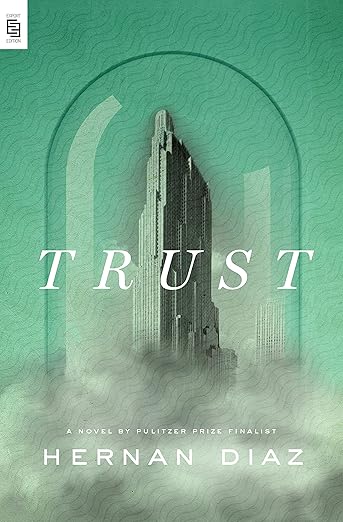
His debut novel, In the Distance (2017), was a finalist for the Pulitzer Prize and established him as a bold and innovative literary voice. However, his second novel, Trust, marked a turning point in his career. Published in 2022, the book received widespread critical acclaim and won the 2023 Pulitzer Prize for Fiction.
Trust significantly elevated Díaz’s international reputation. The novel’s ambitious structure and its exploration of capitalism, financial power, and authorship positioned him as one of the most intellectually daring contemporary writers. The success of Trust confirmed his status as a major figure in 21st-century literary fiction.
In the triumphant 1920s, Benjamin Rask and his wife Helen dominate New York: he, a financial magnate who has amassed a fortune; she, the daughter of eccentric aristocrats. But as the decade draws to a close, and their excesses reveal a dark side, suspicion begins to surround the Rasks…
This is the starting point of “Bonds” (the first part of the book Trust), a bestselling 1937 novel that all of New York seems to have read, and which tells a story that can, however, be told in several other ways.
Trust is divided into four interconnected parts, each offering a different version of the same story and challenging the reader’s understanding of truth and authorship.
The first part, Bonds, is a fictional 1930s novel written by Harold Vanner. It tells the story of Benjamin Rask, a wealthy financier, and his wife Helen, portraying them as distant and tragic figures. That is an external and possibly sensationalist version.
The second part, My Life, is an unfinished autobiography written by Andrew Bevel, a powerful Wall Street magnate who clearly resembles Rask. Bevel seeks to correct what he considers the false portrayal of his life in Vanner’s novel, it is an attempt to control the narrative.
The third part, A Memoir, Remembered, is narrated by Ida Partenza, Bevel’s secretary. She recounts how she was hired to ghostwrite Bevel’s autobiography and gradually uncovers the hidden role of his wife, Mildred. That is a critical outsider's perspective.
The fourth part consists of Mildred Bevel’s private diary, which offers her own fragmented perspective. Together, the four texts reveal how wealth shapes not only history, but also the stories we believe. Mildred's diary is the voice that ultimately reshapes the entire story.
3. Interview and video about the author
YouTube - Service 95 - Hernán Díaz on Writing Trust
YouTube - Service 95 - Dua Lipa In Conversation With Hernan Diaz, Author Of Trust
4. Discussion Questions for Trust (Parts III & VI)
by Hernán Díaz
1. Ida and Mildred: two very different women
How would you compare Ida Partenza and Mildred Bevel? What do they have in
common, and what makes their lives and ambitions very different?
2. Getting closer to the truth
In Part III, Ida learns more about the Bevels and becomes involved in Andrew’s
project. In Part IV, we finally hear Mildred’s own voice.
How does each part change your understanding of what really happened?
3. Who controls whom?
Andrew has enormous financial and social power, while Ida has very little at the
beginning of Part III. Mildred is also in a complicated relationship with Andrew.
Who has power over whom in these relationships? Does this power change
during the novel?
4. Mildred's character
Compare the Mildred we see in “Bonds,” “My Life,” and “Futures.”
Which portrait seems closest to the woman you imagine as the “real” Mildred?
What makes you think so?
5. Writing as a form of power
Andrew wants to control the story of his life, Ida helps him write it, and Mildred also
uses writing to express her own ideas.
How is writing connected to power and control in these two parts? Who is
trying to control the story, and why?
6. The title “Futures”
Why do you think Díaz calls Mildred’s section “Futures”? What different meanings
could the word futures have in relation to Mildred’s life, her relationship with Andrew,
and the financial world of the novel?
Discussion Questions for Trust (Parts I & II) last April's meeting
1. Who do we believe?
In Part I (“Bonds”), we read a story about Benjamin and Helen Rask.
In Part II (“My Life”), Andrew Bevel tells his own story.
○ Which version feels more believable to you?
○ Why?
2. Main Differences
○ What are the biggest differences between Benjamin Rask and Andrew Bevel?
○ How are their wives (Helen and Mildred) different in the two texts?
○ Why do you think these differences are important?
3. How is Wealth Shown?
○ How does each part describe rich people and the world of finance?
○ Does Part I criticize rich people more?
○ Does Part II try to defend them?
4. The Wives’ Role
Compare Helen and Mildred.
○ How intelligent and independent are they in each story?
○ Do they seem strong, controlled, misunderstood, or something else?
5. The 1929 Stock Market Crash
○ How is the crash described in both parts?
○ Is Bevel/Rask responsible in any way?
○ Does each story judge him differently?
6. Writing Style
Part I reads like a traditional novel.
Part II feels like a personal explanation or defense.
○ How does the style change your opinion of the characters?
○ Which style did you prefer?
7. Why Write a Second Version?
○ Why do you think Andrew Bevel wants to tell his own version of the story?
○ What does this say about power and reputation?
8. Loneliness and Power
Both men seem distant and emotionally cold.
○ Why are they like this?
○ Is their personality connected to money and success?
9. What Is the Truth?
○ After reading both parts, do you think we can know the “real” truth?
○ Or does the novel suggest that truth depends on who tells the story?
10. Your Personal Reaction
○ After reading both sections, whose story affected you more?
○ Did your opinion change between Part I and Part II? Why?
Discussion Questions to Use with the Timeline
After reading the timeline, reflect on the following questions:
● How does knowing this timeline change your view of Bevel/Rask?
● Is he a genius investor — or someone who benefits from crisis?
● Does the crash seem like an accident, or something predictable?
5. Financial Vocabulary
Financial Vocabulary from Trust
1. Speculation / Speculative Activity
● Buying shares or assets expecting prices to rise quickly.
● In the novel: Investors in the 1920s (including Rask/Bevel) often take big risks to make fast profits.
2. Stock Market / Trading
● The buying and selling of company shares.
● In the novel: The rise and fall of shares drives the characters’ wealth and anxiety.
3. Market Collapse / Crash
● A sudden, steep fall in stock prices.
● In the novel: The 1929 crash affects everyone’s fortunes and shows the fragility of wealth.
4. Wealth Concentration
● The accumulation of extreme wealth in the hands of very few people.
● In the novel: Bevel’s rise illustrates how few can dominate finance and public perception.
5. Public Perception / Reputation as Currency
● The idea that trust and fame are as valuable as money in maintaining wealth.
● In the novel: Bevel carefully shapes how people see him, almost like managing a financial asset.
6. Financial Risk / Exposure
● The possibility of losing money due to investment decisions.
● In the novel: Risk-taking drives both the success and the near collapse of fortunes.
7. Philanthropy as Social Investment
● Giving money to cultural or educational institutions to secure social influence.
● In the novel: Bevel uses charitable acts to cement his reputation and legitimacy.
8. Economic Downturn / Recession
● A period when the economy slows, businesses fail, and unemployment rises.
● In the novel: The aftermath of the 1929 crash creates wider social and economic consequences.
9. Insider Knowledge / Privileged Information
● Knowing something about markets or investments that most people do not.
● In the novel: Wealthy investors like Bevel benefit from information and influence that ordinary people don’t have.
10. Illusion of Stability
● A false sense that wealth, markets, or power are secure and predictable.
● In the novel: Both narratives show that fortunes can vanish overnight, despite appearances.
6. Mini Financial Timeline: 1929
Before 1929 – The “Roaring Twenties”
● The U.S. economy is growing quickly.
● Many people invest in the stock market.
● Stock prices rise very fast.
● Some people buy shares with borrowed money (this increases risk).
● There is a lot of optimism and speculation.
👉 Connection to the novel: This is the world in which Rask/Bevel becomes extremely wealthy.
Early 1929 – Warning Signs
● Experts begin to worry that stock prices are too high.
● Some investors quietly start selling their shares.
● The market becomes unstable.
👉 Discussion link: Who understands the danger? Who profits from it?
October 24, 1929 – “Black Thursday”
● Many investors panic and try to sell their shares
● Stock prices fall quickly.
● Banks and large investors try to calm the market by buying shares.
October 29, 1929 – “Black Tuesday”
● Panic continues.
● Millions of shares are sold.
● Prices collapse.
● Many investors lose everything.
👉 This is the moment usually called the Stock Market Crash of 1929.
After the Crash (1930s)
● Thousands of banks fail.
● Businesses close.
● Millions of people lose their jobs.
● This period becomes known as the Great Depression.
7. List of characters
1. Correspondences between characters (the “two versions”)
In Bonds
(fictional novel)
In the other
parts
Role in the story
Benjamin Rask
Andrew Bevel
New York financial magnate whose fortune and reputation
are at the center of the story.
Helen Rask
Mildred Bevel
An extremely intelligent and cultured wife; her true role
in the fortune is one of the mysteries of the novel.
Leopold
Helen's Father
Doctor treating Helen
Mildred's Doctors
They intervene during the wife's illness.
This shows how the first part
rewrites real history, changing names and emphasizing certain features.
2. Main Characters for Each Narrator
Bonds - Fictional story inspired by the Bevels.
• Benjamin Rask – mysterious and extremely wealthy financier.
• Helen Rask – brilliant wife whose illness dominates the plot.
________________________________________
My Life (Andrew's autobiography)
• Andrew Bevel – attempts to rebuild his public reputation.
• Mildred Bevel – presented as a refined wife and music lover.
• William Bevel – Andrew's father, a key figure in the creation of his wealth.
• Adelaide Bevel – Andrew's mother, associated with high society.


_(cropped).jpg/500px-Chiang%2C_Ted_(Villarrubia)_(cropped).jpg?utm_source=en.wikipedia.org&utm_campaign=parser&utm_content=thumbnail)