Why should we read it?
It is always a good idea to take a look back at some great classic British novelists. One of the most important characteristics of a master piece is that no matter how long ago it was written, it still has a message or several, to convey to present-day readers and a really meaningful one. I hope you enjoy it as much as I did!!
Source: The following text has been compiled from Wikipedia publications
 |
| Source: Amazon |
Eric Arthur Blair (25 June 1903 – 21 January 1950) was an English novelist, poet, essayist, journalist, and critic who wrote under the pen name of George Orwell. His work is characterised by lucid prose, social criticism, opposition to all totalitarianism (both authoritarian communism and fascism), and support of democratic socialism.
Orwell is best known for his allegorical novella Animal Farm (1945) and the dystopian novel Nineteen Eighty-Four (1949), although his works also encompass literary criticism, poetry, fiction and polemical journalism. His non-fiction works, including The Road to Wigan Pier (1937), documenting his experience of working-class life in industrial Northern England, and Homage to Catalonia (1938), an account of his experiences soldiering for the Republican faction of the Spanish Civil War (1936–1939), are as critically respected as his essays on politics, literature, language and culture.
Orwell's work remains influential in popular culture and in political culture, and the adjective "Orwellian"—describing totalitarian and authoritarian social practices—is part of the English language, like many of his neologisms, such as "Big Brother", "Thought Police", "Room 101", "Newspeak", "memory hole", "doublethink", and "thoughtcrime". In 2008, The Times named Orwell the second-greatest British writer since 1945
Animal farm got it difficult to get published:
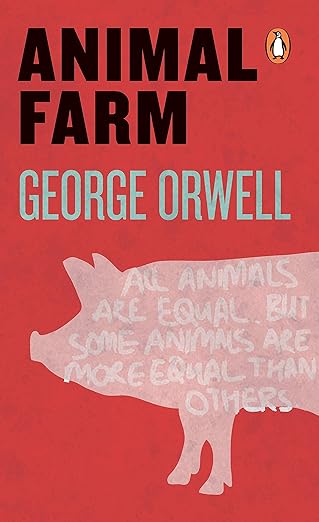
Animal Farm (originally Animal Farm: A Fairy Story) is a satirical allegorical dystopian novella, in the form of a beast fable, by George Orwell, first published in England on 17 August 1945. It follows the mistreated anthropomorphic farm animals of Manor Farm as they rebel against their human master, and are hoping to create a society where all animals can be equal, free, and happy away from human vices and interventions. However, the rebellion is hijacked and betrayed, and under the dictatorship of the pigs, the farm ends up in a dystopian state nearly identical to what it was before.
According to Orwell, Animal Farm reflects events leading up to the Russian Revolution of 1917 and then on into the Stalinist era of the Soviet Union, a period when Russia lived under the Marxist–Leninist ideology of Joseph Stalin. Orwell, a democratic socialist, was a critic of Stalin and hostile to Moscow-directed Stalinism, an attitude that was critically shaped by his experiences during the Barcelona May Days conflicts between the POUM and Stalinist forces, during the Spanish Civil War. In a letter to Yvonne Davet (a French writer), Orwell described Animal Farm as a satirical tale against Stalin ("un conte satirique contre Staline"), and in his essay "Why I Write" (1946) wrote: "Animal Farm was the first book in which I tried, with full consciousness of what I was doing, to fuse political purpose and artistic purpose into one whole."
 |
| Source: Wikipedia |
Orwell wrote the book between November 1943 and February 1944, when the United Kingdom was in its wartime alliance with the Soviet Union against Nazi Germany and the British intelligentsia held Stalin in high esteem, which Orwell hated. The manuscript was initially rejected by several British and American publishers, including one of Orwell's own, Victor Gollancz, which delayed its publication. It became a great commercial success when it did appear, as international relations and public opinion were transformed as the wartime alliance gave way to the Cold War.
No comments:
Post a Comment
Thank you very much for your comment.
We are waiting for you soon!