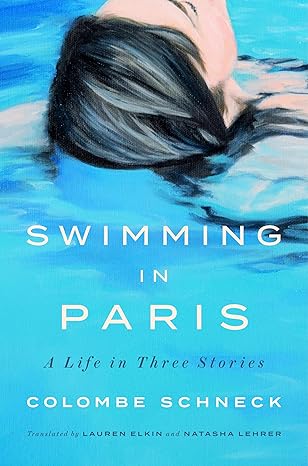
What are you reading? "Swimming in Paris" by Colombe Schneck

 Noelia's contribution

I came across "Swimming in Paris" by Colombe Schneck while browsing Natalie Portman's book club. Although it is not the kind of book I usually read, I want to step out of my comfort zone, and I knew I had to give it a try. The fortuitous nature of this discovery added to the magnetism of the book. Often, it is in these unplanned moments of exploration that one encounters hidden gems.

Swimming in Paris is a memoir divided into three short stories. First one, adolescence, this story is magnetic, a page-turner, talking about sexual identity, familiar relationships and abortion. The second one, titled "Friendship," specifically explores how she sometimes envies and compares her friends, believing their lives are better than hers, until an event occurs that changes her perspective. And the last story, "Swimming in Paris: a Love Story, she narrates the intricate relation between her, her lover and the city.

Schneck's narrative is characterised by its directness and eschewal of unnecessary embellishments, thereby rendering the profound and occasionally taboo themes she explores in an accessible yet potent manner, beckoning readers to introspection and meditation.

To sum up, I highly recommend this book. I feel compelled to voice a criticism of the book, yet I find myself unable to do so. As I see, this book is perfect for a book club session, I know the members of the club would spend several hours arguing about sex identity, abortion rights, loss and love.

The book

Amazon
Swimming in Paris by Colombe Schneck is a delightful memoir that captures the author’s youthful years in the French capital during the 1980s. Schneck portrays Paris with honesty and nostalgia, blending her personal story with the cultural and social atmosphere of the time. Her narrative is intimate yet universal, offering readers a glimpse into the search for freedom, love, and identity. The prose is elegant but accessible, filled with vivid descriptions that transport us directly into cafés, libraries, and swimming pools. This short but memorable book leaves a lasting impression, celebrating the joy and challenges of self-discovery.


About Colombe Schneck

Wikipedia
Colombe Schneck is a French writer, journalist, and documentary filmmaker born in Paris in 1966. She studied at Sciences Po and built a career in television and radio before dedicating herself fully to writing. Schneck has published several acclaimed novels and autobiographical works, often exploring themes of family, memory, and women’s experiences. Her style combines sensitivity with sharp observation, allowing her to create stories that resonate deeply with readers. With Swimming in Paris, she offers a personal reflection on youth, independence, and the meaning of belonging. Schneck continues to be an important literary voice in contemporary French literature.

What are you reading? Lord of the flies by William Golding

 Ana Melendo's contribution

This novel tells the story of a group of boys on a remote island after the plane they were traveling in crashed. First, I appreciated the rich language describing the abundant nature as well as the portrayal of the characters who are so different from each other. At first glance, the story doesn’t seem original, but without a doubt, it should rather be taken as an allegory of social relations. If we limit ourselves to reading it as the story of the adventures and misadventures of a group of boys, it is also very captivating. I won’t tell you more, but I strongly encourage you to discover it.


The Book

Amazon
William Golding’s Lord of the Flies (1954) remains one of the most striking allegories of human nature in modern literature. The novel tells the story of a group of boys stranded on a deserted island who attempt to govern themselves, only to fall into violence and chaos. What begins as an innocent attempt at democracy quickly unravels, exposing fear, cruelty, and the fragile veneer of civilization. Golding suggests that darkness is not imposed from the outside but lies within every human being.

The book has generated intense discussion since its publication. Critics have interpreted it as a commentary on the brutality of war, a reflection on the failure of rational order, and a warning about unchecked instincts. It is often taught in schools because of its accessible narrative and deep symbolism, particularly in its treatment of power, morality, and the loss of innocence. Though sometimes controversial, Lord of the Flies has secured its place as a classic, shaping how readers and scholars think about human behavior under extreme conditions. Its haunting vision continues to resonate today, reminding us of the thin boundary between civilization and savagery.

The Author

William Golding (1911–1993) was an English novelist, playwright, and poet best known for his deeply symbolic fiction. Born in Cornwall, he studied English literature at Oxford and later became a teacher. His experience in the classroom, combined with his service in the Royal Navy during World War II, profoundly influenced his view of humanity and the themes that would define his writing.

Golding’s literary breakthrough came with the publication of Lord of the Flies in 1954, which established his reputation as a major voice in postwar literature. He continued to explore the complexities of human nature in novels such as The Inheritors (1955), Pincher Martin (1956), and The Spire (1964). His works often confront moral dilemmas, the tension between civilization and barbarism, and the destructive impulses hidden beneath social order.

In 1983, Golding was awarded the Nobel Prize in Literature, recognized for his ability to illuminate “the human condition in the world of today.” He was knighted in 1988 and remained a respected figure in English letters until his death in 1993. Golding’s legacy endures through his novels, which continue to challenge readers to reflect on the depths of human behavior.

The novel was adapted into a film in 1990. Lord of the Flies is an American survival drama film directed by Harry Hook. You can watch it in the attached YouTube video.


What are you reading: " TRUST by Hernan Diaz"

Marta Moreno's contribution

 The Book & The Author

Wikipedia
TRUST by HERNAN DIAZ. When I first heard about Trust in the New York Times 100 Best Books of the 21st Century, I felt intrigued by the fact that an Argentinian writer had won the Pulitzer Prize with a novel written in English. I bought it a few days later and left it to sleep on a bookshelf. 

I have always felt fascinated by those who live between two languages and those who feel more at home writing in a language that is not their mother tongue. This is the case of Joseph Conrad, who apparently was hard to understand when speaking because he had such a thick Polish accent. And nowadays we have the example of Junot Diaz, whose novel The Wondrous Life of Oscar Wao drifts seamlessly from Spanish to English and back. On the other side of the spectrum, Benjamin Labatut has chosen to write Un verdor terrible and Maniac in Spanish but he could perfectly have written these books in English. However, in his own words, they would have been totally different. Far from comparing myself with such geniuses, I’d say that I often find it easier to express myself in English than in Spanish when it comes to writing, and I feel that my voice is definitely different in each language.

I imagined Diaz as the child of immigrants who spent most of his life in the US, but in this I was mistaken. It’s true that his parents had to flee the Argentinian dictatorship when he was very little,  seeking asylum in Sweden. This is how he ended up growing up bilingual, speaking Spanish at home and Swedish at school and in the rest of his everyday life. One day a novel in English fell into his hands and he fell unexpectedly in love with American literature. Little by little, with the help of a dictionary he followed the story and this was the beginning of his lifelong passion. 

Hernan Diaz studied English Literature in Argentina, where his family returned in the 1980s, continued his studies at King’s College London and, to cut a long story short, became a professor at Columbia University in New York.

Amazon
When finally I picked up Trust this summer, I found myself immediately absorbed in a tale that reminded me of the great classics. The book, which  tells the story of the richest man in the world and his problematic relationship with his wife, is divided into four parts: the first one is a novel inside the novel, the second the notes for an autobiography written by somebody who reminds us of the main character of the first part, the third the memoirs of the secretary who helped write the autobiography, and the fourth the journal of the other key character, the wife. Only when reaching the end will we be able to put all the pieces of the puzzle together and pass judgment on each of the characters. 

The book can be obscure sometimes, especially when it gets into detail about the financial operations that make the protagonist amass his legendary wealth. If you are familiar with this field, this will surely add to the enjoyment of this masterpiece. If not, as it was my case, it will not stop you from relishing every single line of this novel. 


What are you reading? Mrs. Van Gogh by Caroline Cauchi

 Noelia's contribution

The Book

Source: Amazon
Mrs. Van Gogh by Caroline Cauchi is a powerful historical novel that illuminates the remarkable life of Johanna Van Gogh-Bonger, Vincent Van Gogh's sister-in-law. Following the death of her husband, Theo, Johanna took it upon herself to secure Vincent's legacy, passionately working to promote his art and ensure his rightful place in history through prominent exhibitions of his paintings.

The opening section of the book powerfully emphasises the crucial contributions of female painters and sculptors such as Berthe Morisot, Marie Bracquemond, Mary Cassatt, and Camille Claude, who played vital roles in the Impressionist movement. These pioneering women, whose remarkable artistic talents were unjustly overshadowed by their male counterparts, are finally receiving the recognition they rightfully deserve.

Specifically, the author explains in detail the life of Camille Cloudel, who was Auguste Rodin's student, workmate and lover. As a talented sculptor, Claudel's story is a testament to the challenges faced by women artists in the late 19th and early 20th centuries. Her tumultuous relationship with Auguste Rodin, a prominent figure in the art world, adds a layer of complexity to her narrative. Claudel's sculptures showcase her exceptional skill and artistry. Despite her talent, she struggled to gain recognition in a male-dominated field. The book sheds light on her remarkable life, including her early days as a student, her relationships, and her struggles with mental health.

Another key strength of the novel lies in its first-person narrative, which delivers an intimate and immersive reading experience. The incorporation of actual letters exchanged between Vincent and Theo Van Gogh decisively adds authenticity to the story, enabling readers to gain a profound insight into the brothers' thoughts, emotions, experiences, and the complexities of their relationship.

While the book has some notable weaknesses, particularly in its final chapter, it feels hastily written and lacks depth. Rushed conclusion significantly diminishes the overall impact of the narrative. As a result, I am understandably disappointed as a reader.

I am hesitant to recommend this novel. However, for readers who are unfamiliar with Vincent Van Gogh's life and work, the book can serve as a valuable introduction to the artist's world. It also highlights the often-overlooked contributions of women to the Impressionist movement, making it a worthwhile read for art enthusiasts.

 However, for those seeking a more in-depth understanding of Johanna Van Gogh-Bonger’s life, a specialised biography may be a better choice. Additionally, the novel has pacing issues and lacks nuance in certain areas, which may detract from the reading experience for readers already knowledgeable about the subject.


The Author

Amazon
Caroline Cauchi is a multifaceted author known for her historical novels that explore the lives of remarkable women. Her writing often weaves together meticulous research, vivid storytelling, and a deep appreciation for the human experience.

Her work is characterised by her ability to breathe life into the past, bringing forgotten figures to the forefront of historical narratives. Her novels often focus on the experiences of women who have been overlooked or underappreciated, shedding light on their struggles, triumphs, and contributions to society.

  Through her writing, Cauchi demonstrates a commitment to authenticity and historical accuracy. Her novels are meticulously researched, drawing on primary sources and historical records to create immersive and engaging narratives. 


Interesting Links